Introduction
The South China Sea (SCS) remains one of the most contested geopolitical flashpoints in the Indo-Pacific, with China’s assertive territorial claims and militarization challenging the rules-based international order. The recent incident on August 11, 2025, where two Chinese military vessels collided while harassing a Philippine Coast Guard ship near Scarborough Shoal, underscores the recklessness of Beijing’s gray-zone tactics and the potential for miscalculation. As a Pacific power with treaty allies in the region, the United States has a strategic imperative to counter China’s dominance, ensure freedom of navigation, and reassure partners like the Philippines and Japan. Increasing Carrier Strike Group (CSG) patrols in the SCS offers a robust, visible, and credible means to achieve these objectives, while carefully managing escalation risks. This article argues that a sustained but rotational CSG presence is essential to deter Chinese aggression, uphold international law, and safeguard U.S. interests in the Indo-Pacific.
The Strategic Case for Increased CSG Patrols
- Deterring Chinese Aggression and Gray-Zone Tactics
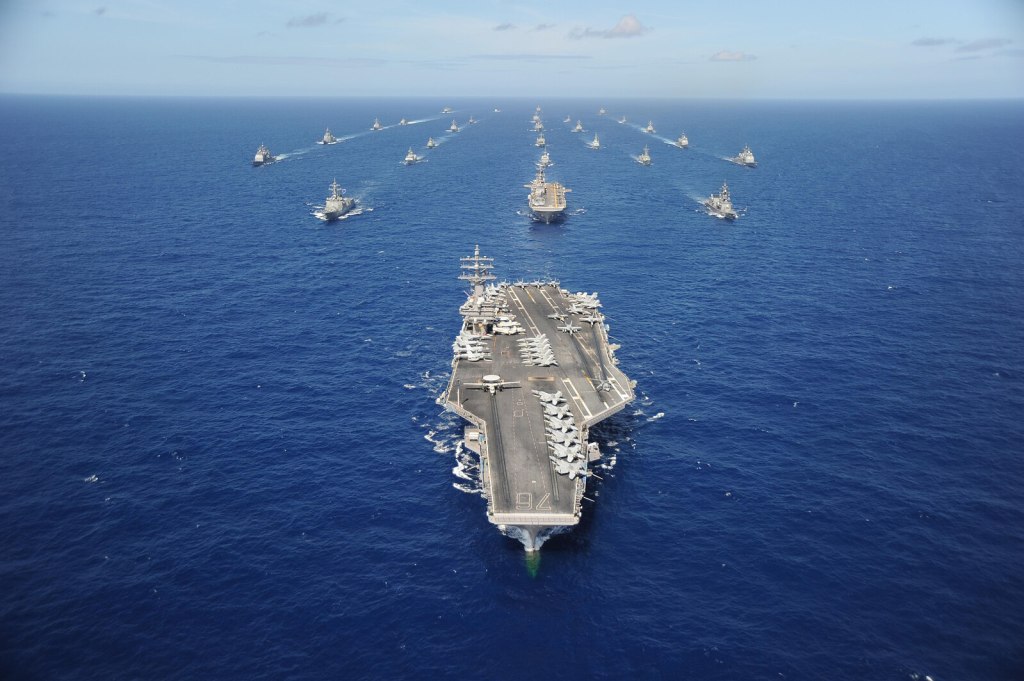
China’s expansive claims over 90% of the SCS, despite the 2016 Hague ruling invalidating its “nine-dash line,” are backed by a growing naval presence, including artificial island bases and a maritime militia that intimidates smaller claimants like the Philippines. The August 11 collision, where a Chinese Coast Guard ship and a People’s Liberation Army Navy (PLAN) destroyer damaged each other while chasing a Filipino vessel, reveals both China’s aggressive intent and its operational vulnerabilities. Such incidents highlight the need for a strong U.S. deterrent to prevent further coercion.A CSG, typically comprising an aircraft carrier, guided-missile destroyers, cruisers, and submarines, projects unmatched military power, capable of dominating air and sea domains. Unlike routine Freedom of Navigation Operations (FONOPs), which involve single ships challenging excessive claims, a CSG’s presence signals unwavering U.S. resolve to counter China’s incremental encroachments. For instance, the USS Ronald Reagan’s dual-carrier exercises in 2020 deterred Chinese escalation during heightened tensions. By increasing CSG patrols, the U.S. can raise the costs of China’s gray-zone tactics, forcing Beijing to reconsider actions that risk direct confrontation with a superior naval force.
- Reassuring Allies and Strengthening Regional Coalitions
The U.S. has treaty obligations under the 1951 Mutual Defense Treaty (MDT) with the Philippines, reaffirmed in 2025 by the Trump administration, and a strategic partnership with Japan under the ANZUS framework. The Philippines, facing repeated Chinese provocations at Scarborough Shoal and Second Thomas Shoal, has called for multilateral action, as emphasized by Defense Secretary Gilberto Teodoro Jr. after the August 11 incident. A visible CSG presence would bolster Manila’s confidence, ensuring it does not feel abandoned against China’s numerical superiority (e.g., 40 ships deployed at Sabina Shoal in July 2025).Moreover, CSG patrols can enhance multilateral cooperation with allies like Japan, Australia, and Canada, who participated in the June 2025 Maritime Cooperative Activity (MCA). Joint exercises with a CSG, such as the annual Balikatan drills involving 16,000 U.S. and Filipino troops, demonstrate interoperability and collective resolve. A rotational CSG presence would encourage “minilateral” coalitions, like the U.S.-Philippines-Japan trilateral, without provoking China into perceiving a NATO-like encirclement. This reassurance is critical to prevent allies from hedging toward accommodation with Beijing.
- Upholding Freedom of Navigation and International Law
The SCS is a vital artery for global trade, with $3.4 trillion in annual commerce transiting its waters. China’s militarized outposts and maritime militia threaten freedom of navigation, undermining the United Nations Convention on the Law of the Sea (UNCLOS). Regular CSG patrols would reinforce U.S. commitment to a rules-based order, challenging China’s attempts to establish de facto control over disputed areas. Unlike smaller FONOPs, a CSG’s sustained presence can monitor and respond to Chinese activities across a broader area, deterring blockades like those at Second Thomas Shoal.The U.S. can amplify the diplomatic impact of CSG patrols by publicizing Chinese violations, as the Philippines did with footage of the August 11 collision. By integrating intelligence, surveillance, and reconnaissance (ISR) assets within a CSG, the U.S. can document and expose China’s actions in international forums, such as the UN or G7, reinforcing the 2016 arbitration ruling and isolating Beijing diplomatically.
- Countering China’s Naval Modernization
China’s PLAN has grown into the world’s largest navy by ship count, with 370 vessels and advanced capabilities like the Type 055 destroyer. Its militarized islands, equipped with anti-ship missiles and airfields, pose a direct challenge to U.S. naval dominance. A CSG, with its carrier air wing and integrated missile defense systems, remains a qualitative counterweight to China’s numerical advantage. Regular patrols would allow the U.S. Navy to test Chinese responses, gather intelligence on PLAN operations, and refine tactics to maintain superiority in a potential conflict.The August 11 incident exposed coordination weaknesses in China’s naval operations, suggesting that a CSG’s overwhelming presence could exploit such vulnerabilities, deterring risky maneuvers. Moreover, CSG patrols would signal to Beijing that its militarization efforts will not go unchallenged, encouraging restraint in disputed areas.
Managing Risks of Escalation
Critics argue that increased CSG patrols could provoke China, risking miscalculation and conflict. Beijing’s rhetoric, as seen in its Defense Ministry’s warnings against foreign naval presence, suggests sensitivity to U.S. actions. However, a rotational rather than permanent CSG presence mitigates this risk by avoiding the appearance of a fixed challenge to Chinese sovereignty. The U.S. can further reduce tensions by:
- Coordinating with Allies: Conducting CSG patrols as part of multilateral exercises with the Philippines, Japan, and Australia diffuses the perception of unilateral U.S. aggression. This approach aligns with Manila’s preference for leading its own maritime operations, as noted by Gen. Romeo Brawner Jr., while leveraging U.S. power.
- Clear Signaling: Publicly framing CSG patrols as routine operations to uphold UNCLOS, not targeted provocations, can limit Chinese overreactions. Diplomatic backchannels, as used in the July 2024 Philippines-China resupply agreement, can clarify U.S. intentions.
- Avoiding Sensitive Areas: Positioning CSGs outside China’s claimed 12-nautical-mile territorial waters around disputed features prevents direct confrontations while maintaining a robust presence.
The U.S. Navy’s experience in managing escalatory risks, such as during dual-carrier operations in 2020, demonstrates its ability to deploy CSGs effectively without triggering conflict. By integrating patrols with diplomatic efforts, the U.S. can maintain pressure on China while preserving stability.
Operational and Resource Considerations
Deploying CSGs is resource-intensive, with the U.S. Navy’s 11 carriers stretched across global commitments. However, a rotational schedule—deploying one CSG for 2–3 months annually, timed with key regional events like Balikatan or Philippine resupply missions—maximizes impact without overextending forces. The U.S. can also leverage forward-deployed assets in Japan (e.g., USS Ronald Reagan) and Enhanced Defense Cooperation Agreement (EDCA) sites in the Philippines to support CSG operations, enhancing efficiency. To complement CSG patrols, the U.S. should continue investing in the Philippines’ maritime capabilities, providing drones, radar, and fast-attack craft through the $475 million Southeast Asia Maritime Security Initiative. This empowers Manila to counter Chinese aggression independently, reducing the need for permanent U.S. naval deployments.
Conclusion
Increasing Carrier Strike Group patrols in the South China Sea is a strategic necessity to deter Chinese aggression, reassure allies, uphold international law, and counter Beijing’s naval modernization. A rotational CSG presence, integrated with multilateral exercises and diplomatic efforts, strikes a balance between demonstrating resolve and managing escalation risks. By leveraging the August 11, 2025, incident to highlight China’s vulnerabilities and rallying allies around a rules-based order, the U.S. can reinforce its role as the Indo-Pacific’s preeminent power. Failure to act risks ceding strategic ground to China, undermining U.S. credibility, and emboldening further coercion in one of the world’s most critical regions. The U.S. Navy must sail forward with confidence, ensuring the South China Sea remains open and free.
 Catalyst International
Leave a comment