Introduction
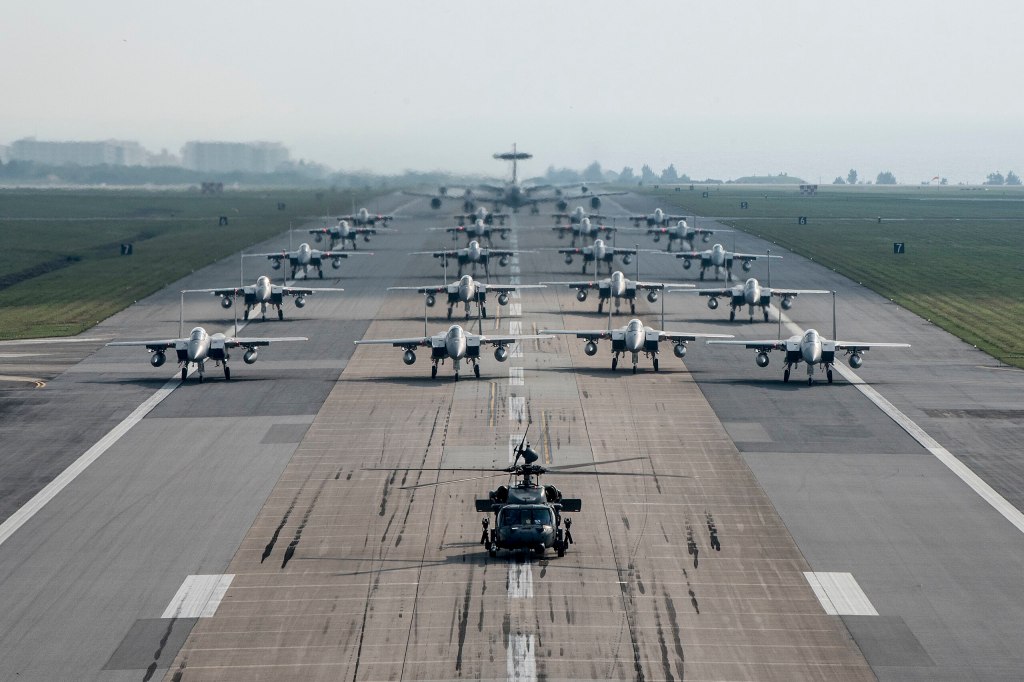
Kadena Air Base, the “Keystone of the Pacific,” is the United States’ cornerstone military hub in the Indo-Pacific, critical for projecting power in a potential Taiwan conflict. Located just 400 miles from Taiwan and 650 km from China, Kadena hosts the 18th Wing, the U.S. Air Force’s largest combat wing, with over 23,000 personnel—military, civilian, and Japanese employees—and key assets like F-15 Eagles, KC-135 Stratotankers, and E-3 Sentries. Yet, its strategic importance is overshadowed by significant vulnerabilities to Chinese missile attacks, as outlined in a 2022 War on the Rocks analysis, which highlights Kadena’s exposure to the People’s Liberation Army Rocket Force (PLARF) and its thousands of precision-guided missiles. Compounding this challenge, tensions with Okinawan communities over the U.S. military footprint—particularly Marine Corps Air Station (MCAS) Futenma and the controversial Henoko base construction—threaten operational stability and local goodwill.This article proposes a transformative strategy: close MCAS Futenma, cancel the Henoko base, and redirect the resulting savings to fortify Kadena through advanced anti-missile defenses, hardened infrastructure, and enhanced cybersecurity. This approach strengthens Kadena’s resilience against Chinese threats, protects its 23,000 personnel, and returns significant land to Okinawans, fostering community harmony. By consolidating U.S. forces in a fortified Kadena while dispersing other assets, the U.S. can enhance deterrence, operational effectiveness, and regional relations, creating a win-win for all stakeholders.
The Strategic Imperative: Kadena’s Role and Vulnerabilities
Kadena’s proximity to Taiwan makes it indispensable for air superiority, refueling, and reconnaissance in a Taiwan conflict, where rapid response is paramount. Its two 12,000-foot runways and 46-square-kilometer footprint support high-tempo operations, hosting over 80 aircraft and a diverse mission set, from combat to logistics. However, this concentration of assets makes Kadena a prime target for China’s PLARF, which possesses thousands of short-range ballistic missiles (e.g., DF-16, DF-17) and cruise missiles capable of overwhelming its current Patriot PAC-3 defenses. The War on the Rocks article notes that Kadena’s “soft targets”—unprotected aircraft, runways, and ground equipment—are highly vulnerable to precision strikes, potentially neutralizing the base early in a conflict and endangering its 23,000 personnel. Cyber vulnerabilities, including risks to radar and command systems, and limited warning time (under 10 minutes for missile strikes) further erode its survivability. Meanwhile, MCAS Futenma and the planned Henoko base, both in Okinawa, face similar missile threats but lack Kadena’s strategic importance. American officials have previously referred to Futenma as “the most dangerous military base in the world,” with former President Bill Clinton calling for its closure in 1996. American officials have also stated that the replacement for Futenma Air Base need not be located in Okinawa, but could be moved to mainland Japan or elsewhere. Futenma, located in densely populated Ginowan, hosts rotary-wing assets (e.g., MV-22 Ospreys) but is less critical for air-centric Taiwan scenarios compared to Kadena’s fighter and tanker operations. Henoko, intended as Futenma’s replacement, remains stalled by local opposition over environmental damage (e.g., dugong habitats, legal challenges, and structural feasibility issues. Both bases fuel Okinawan resentment, driving protests that disrupt U.S. operations and empower pro-China sentiment. Closing Futenma and halting Henoko would free resources to bolster Kadena while addressing community concerns, aligning strategic and diplomatic objectives.
Proposed Enhancements for Kadena’s Security
To ensure Kadena’s resilience and safeguard its 23,000 personnel, the U.S. should implement three key upgrades within its existing 46-square-kilometer footprint:
- Advanced Anti-Missile Defenses:
- Deploy a Terminal High Altitude Area Defense (THAAD) battery to complement Kadena’s Patriot PAC-3 systems, enabling midcourse and terminal-phase interception of ballistic missiles. A single THAAD battery, including 48–64 interceptors, an AN/TPY-2 radar, and fire control systems, costs approximately $1–$1.5 billion, with 100–200 additional interceptors at $1–$3 billion to counter China’s extensive missile inventory. Annual operating costs are $50–$100 million.
- Integrate with Japan’s Aegis-equipped destroyers for a layered defense, leveraging existing regional assets to enhance interception rates and reduce costs.
- Hardened Infrastructure:
- Construct 40–50 hardened aircraft shelters (HAS) to protect Kadena’s ~80–100 aircraft from missile submunitions, costing $160–$500 million. Reinforced command bunkers ($100–$150 million) and rapid runway repair kits ($20–$100 million) ensure operational continuity if runways are damaged, leveraging Kadena’s existing two runways to maintain sortie rates.
- Environmental mitigation, such as PFOS cleanup ($10–$50 million), addresses past contamination issues to align with Okinawan concerns.
- Enhanced Cybersecurity:
- Upgrade networks with AI-driven threat detection and redundant systems ($50–$200 million) to counter cyberattacks that could disrupt radar or command systems critical for missile defense and air operations. Electronic warfare countermeasures ($20–$100 million) protect against Chinese jamming, with annual training and exercise costs of $5–$20 million.
Total Estimated Cost: $2.97–$7.1 billion initial, $55–$120 million annually, including $500 million–$1 billion to relocate Futenma’s assets to Kadena, Guam, or Iwakuni.
Funding Through Strategic Realignment
Closing MCAS Futenma and halting the Henoko base construction provides the financial and diplomatic means to fund Kadena’s upgrades:
- MCAS Futenma Closure: Shutting down Futenma saves $100–$200 million annually in operating costs and avoids $500 million–$1 billion in future upgrades. Returning its 4.8 square kilometers to Ginowan supports urban redevelopment, reduces noise complaints, and addresses environmental concerns (e.g., PFOS contamination).
- Henoko Cancellation: Canceling the $8–$12 billion Henoko project, despite $1–$2 billion in sunk costs, frees $6–$11 billion. Returning its 1.5 square kilometers mitigates environmental damage to dugong habitats and reduces local opposition.
- Net Financial Impact: Savings from Henoko ($6–$11 billion) and Futenma ($100–$200 million annually) offset Kadena’s upgrade costs ($2.97–$7.1 billion initial, $55–$120 million annually), yielding a net savings of roughly $8.03 billion long-term. Annual savings cover Kadena’s ongoing costs, with surplus for community investments, such as economic aid or environmental cleanup.
Strategic and Community Benefits
- Strengthened Kadena:
- The proposed upgrades address Kadena’s vulnerabilities, enabling it to withstand Chinese missile barrages and sustain operations in a Taiwan conflict. THAAD counters ballistic and hypersonic threats, hardened infrastructure protects aircraft and command systems, and cybersecurity safeguards operational networks, ensuring the safety of Kadena’s 23,000 personnel.
- With two existing runways, Kadena’s fortified posture enhances its role as a deterrence hub, signaling U.S. commitment to defending Taiwan and Japan while maintaining high-tempo air operations.
- Improved Okinawan Relations:
- Returning 6.3 square kilometers from Futenma and Henoko addresses Okinawan grievances over land use, noise, and environmental damage, significantly reducing protests that disrupt America’s interests. This fosters community goodwill, improving access and operational stability, while decreasing the growth of pro-Chinese sentiment.
- Environmental mitigation at Kadena, funded by savings, builds trust by addressing PFOS contamination and other concerns, aligning with Okinawan priorities.
- Alignment with Dispersal Strategy:
- The War on the Rocks article advocates dispersing forces to less vulnerable bases (e.g., Guam, Iwakuni) to counter China’s anti-access/area denial (A2/AD) strategy, which targets Okinawa’s bases with short-range missiles. Closing Futenma and Henoko supports this by relocating Marine Corps assets to safer locations, reducing the U.S. footprint in the First Island Chain.
- A fortified Kadena will improve its ability to rapidly respond in the event of a conflict, while remaining viable for later conflict stages or peacetime operations, as the article suggests, balancing centrality with resilience.
Challenges and Mitigation
- Geopolitical Risks:
- Closing Futenma and halting Henoko could strain U.S.-Japan relations, as the 1996 relocation agreement was a cornerstone of alliance cooperation. Diplomatic engagement, emphasizing Kadena’s enhanced role and Marine Corps dispersal to Guam or mainland Japan, can reassure Tokyo of U.S. commitment to regional security.
- Transparent communication with allies like South Korea and Taiwan is essential to avoid misperceptions of a reduced U.S. presence, highlighting Kadena’s fortified deterrence role.
- Operational Transition:
- Relocating Futenma’s rotary-wing assets (e.g., MV-22 Ospreys) to Kadena, Guam, or Iwakuni requires 1–3 years and $500 million–$1 billion, potentially creating a temporary readiness gap. Preemptive planning, such as expanding HAS at Kadena (included in the $160–$500 million hardening budget), ensures continuity.
- Kadena’s existing infrastructure, including two runways, can absorb additional aircraft with minimal disruption, supported by the proposed upgrades.
- Local Sensitivities:
- While Kadena’s renovations stay within its footprint, increased operations or THAAD deployment could raise noise or safety concerns among Okinawans. Proactive community engagement, including economic investments (e.g., job programs) and environmental cleanup ($10–$50 million), is critical to sustain the win-win outcome and minimize the growth of pro-China sentiment.
- Lessons from Henoko’s opposition underscore the need for early consultation with Okinawan leaders to preempt protests, ensuring Kadena’s upgrades are seen as a net positive.
Conclusion
Fortifying Kadena Air Base through advanced anti-missile defenses, hardened infrastructure, and enhanced cybersecurity, funded by closing MCAS Futenma and canceling the Henoko base, is a strategic and diplomatic triumph. This approach protects Kadena’s 23,000 personnel, strengthens its resilience for a Taiwan conflict, and saves up to $8.03 billion by redirecting resources from less critical, more vulnerable bases. Returning 6.3 square kilometers to Okinawans addresses longstanding grievances, reducing tensions and fostering community harmony. By aligning with the dispersal strategy outlined in War on the Rocks, this plan ensures the U.S. maintains a robust Indo-Pacific posture while building trust with local stakeholders. The U.S. and Japan must act decisively, leveraging diplomatic engagement and environmental mitigation to realize this transformative vision for Kadena’s future.
 Catalyst International
Leave a comment